

Natural language IVR (NL-IVR) is an AI-driven phone front end that understands free-form speech, extracts caller intent, and automates routine requests without menus or button presses. For Australian businesses fielding dozens of calls a day, that shift has three immediate consequences:
- Callers say what they need in plain English and get a resolution in seconds, not minutes.
- Routine calls (bookings, status checks, payments) are handled without an agent, freeing staff for complex work.
- Missed calls and misrouted calls drop, protecting revenue that would otherwise walk to a competitor.
The technical components that make this possible are covered in the next section.
Key takeaways
Natural language IVR delivers the highest ROI when you automate your top routine call types first, measure containment from day one, and treat conversational design as seriously as the underlying technology.
| Point | Details |
|---|---|
| Start with your top intents | Automate your three to five most frequent, most repetitive call types first for the fastest measurable ROI. |
| Measure containment from day one | Track containment rate, transfer rate, AHT, and CSAT from the pilot's first week so you have a baseline to improve against. |
| Design for ambiguity | Build clarifying prompts and explicit fallbacks; a system that guesses intent will misroute callers and undermine trust. |
| Australian compliance is non-negotiable | Confirm data residency, encryption, NDB breach notification, and PCI compliance before signing any vendor contract. |
| Nexwin for Australian SMEs | Nexwin's AI phone receptionist answers calls 24/7 in an Australian voice, books appointments, and captures caller details on a flat monthly subscription. |
Table of Contents
- How does natural language IVR work?
- How does NL-IVR differ from legacy DTMF and basic conversational IVR?
- What are the practical benefits for customers, contact centres, and businesses?
- High-impact use cases for Australian service businesses
- How to implement NL-IVR: a step-by-step checklist
- Security, privacy, and Australian compliance checklist
- How to measure success and build an ROI case
- How does NL-IVR fit with chatbots and omnichannel experiences?
- What Australian businesses need to know before adopting NL-IVR
- The case for acting now, not next quarter
- Nexwin answers calls your business would otherwise miss
- Sources
How does natural language IVR work?
At its core, a natural language IVR system chains together four technologies, each handing off to the next in under a second. The Conversation Design Institute documents these components as automatic speech recognition (ASR), natural language understanding (NLU), dialog management, and text-to-speech (TTS).
| Component | What it does | Why it matters |
|---|---|---|
| ASR (Automatic Speech Recognition) | Converts the caller's audio into text | Accuracy across Australian accents and background noise determines whether the system hears correctly |
| NLU / NLP | Extracts intent and entities from the text | Lets the system understand "I need to move my Tuesday appointment to Thursday afternoon" as a reschedule request, not a cancellation |
| Dialog manager | Tracks conversation state and decides the next action | Handles follow-up questions, context from earlier in the call, and multi-intent utterances |
| NLG / TTS | Generates a spoken reply | Modern large language model (LLM) backends produce natural, contextually appropriate responses rather than pre-recorded clips |
| Integrations | Connects to CRM, calendar, payments, knowledge base | Turns intent into action — booking the appointment, pulling the account balance, or routing to the right agent |
AWS explains that IVR systems connect to back-end services through computer telephony integration (CTI), which is the bridge that lets a voice interaction trigger a calendar booking or a payment transaction.
A micro call flow example. A caller rings a physio clinic and says: "I'd like to book a new patient appointment for next week, and I also want to check if you bulk bill." The ASR transcribes the sentence. The NLU layer, drawing on natural language processing techniques, identifies two intents: book appointment and billing enquiry, plus entities: new patient, next week. The dialog manager resolves the billing question first (yes/no answer from the knowledge base), then asks a clarifying question to pin down the preferred day. Once confirmed, it writes the booking to the calendar and sends an SMS confirmation. No agent involved.
Pro Tip: Train your ASR and NLU on real call recordings from your own business. Generic training data will miss the phrases your callers actually use — suburb names, product nicknames, and industry-specific terms that generic models get wrong.
How does NL-IVR differ from legacy DTMF and basic conversational IVR?
The gap between a traditional touch-tone IVR and a natural language system is wider than most buyers expect. GetVoIP's analysis of conversational IVR puts it plainly: legacy IVR forces callers into menus and short keyword phrases, while modern conversational systems open with "How can I help you today?" and work from there.
Three-way comparison
| Feature | Legacy DTMF IVR | Basic conversational IVR | Natural language IVR |
|---|---|---|---|
| Input method | Keypad digits or single keywords | Short spoken phrases mapped to menu options | Free-form sentences, multi-intent utterances |
| Caller experience | "Press 1 for billing, press 2 for support" | "Say 'billing' or 'support'" | "Tell me what you need" |
| Misroute risk | High — callers guess the right menu branch | Moderate — limited vocabulary causes failures | Lower — intent extraction handles paraphrase and compound requests |
| Containment potential | Low for complex requests | Moderate | High for routine and moderately complex tasks |
| Redesign effort to upgrade | Low to moderate | Moderate | Higher upfront, lower ongoing maintenance |
Phrases that break legacy IVR are exactly where NL-IVR earns its keep:
- "I want to cancel my appointment but also ask about rescheduling" (two intents, one sentence)
- "Can someone call me back this arvo?" (Australian colloquial, time-specific callback)
- "My hot water system stopped working last night" (open problem statement with no menu match)
The operational implication is real. Upgrading from DTMF to NL-IVR is not a configuration change — it requires intent mapping, conversational design, and ongoing governance. Budget for that work upfront, or containment rates will disappoint.
What are the practical benefits for customers, contact centres, and businesses?
The benefits split cleanly across three groups, and decision makers should map each to a metric they already track.
For customers
- Lower effort: callers state their need once, in their own words, rather than navigating menus.
- Faster resolution: routine requests resolve in the same call without a transfer.
- Better accessibility: callers who struggle with keypads (elderly, vision-impaired, hands-free) get a natural interaction.
- Fewer transfers: context collected upfront means the right agent gets the call with full background, not a cold handover.
For contact centre teams
- Agents receive pre-qualified calls with intent and account data already surfaced.
- Repetitive, low-value calls (hours, directions, basic status checks) are handled before they reach the queue.
- Agent occupancy improves because the calls that do reach agents are genuinely complex and worth the time.
For the business
- Cost per contact falls when containment rises. A call handled entirely by the IVR costs a fraction of an agent-handled call.
- Booking and lead capture rates increase because the system answers at 2 AM on a Sunday, not just during business hours.
- NPS and Customer Effort Score (CES) improve when callers stop fighting menus. TTEC's industry analysis notes that NLP-powered IVR reduces caller frustration and improves containment compared with menu-based systems.
Key metrics to track: containment rate, average handling time (AHT), transfer rate, containment accuracy (did the system resolve the right intent?), and CSAT/CES scores from post-call surveys.
High-impact use cases for Australian service businesses
The fastest ROI comes from automating the calls your team answers on autopilot. For most Australian service businesses, that means:
- Appointment bookings and reschedules — the single highest-volume automatable task for clinics, salons, and allied health practices.
- Job booking and quote capture for tradies — a caller describes the job, the system captures name, address, and job type, and books a time slot.
- Status checks — "Where is my technician?" or "Has my referral been processed?" answered from live CRM data.
- Basic payments — account balance queries and payment processing over voice, with PCI-compliant handling.
- Callback scheduling — caller requests a callback at a specific time; system logs it and triggers the outbound call.
- Lead capture for real estate — property enquiries captured after hours, with caller details pushed to the CRM before the agent starts their day.
Mini scenario 1 — trades. A plumber's phone rings at 7 PM. The caller says: "My kitchen tap is leaking badly, I need someone tomorrow morning." The NL-IVR captures the job type (tap repair), urgency (next morning), and the caller's address. It checks the calendar, offers two available slots, and books the one the caller picks. The plumber wakes up to a confirmed job in their calendar with full notes.
Mini scenario 2 — allied health. A physio patient calls on Saturday afternoon to reschedule. The system recognises the caller's number, retrieves their upcoming appointment, and offers three alternative slots. The patient picks one, receives an SMS confirmation, and the clinic's calendar updates in real time. Zero staff involvement.

For real estate agencies, Nexwin's AI receptionist for real estate shows how this plays out in practice: after-hours enquiries captured, caller details logged, and follow-up triggered before the next business day.
How to implement NL-IVR: a step-by-step checklist
A phased rollout reduces risk and gets you to measurable ROI faster than a big-bang deployment.
- Discovery — pick your top 3–5 intents. Audit your call logs for the most frequent, most repetitive request types. Appointment bookings, status checks, and basic FAQs are almost always in the top five. These are your pilot intents.
- Data collection. Pull real call recordings and transcripts. Label intents and entities, including edge cases and the phrases callers use that you did not expect. Generic training data will not capture your callers' vocabulary.
- Conversational design. Map each intent to a dialog flow. Build clarifying prompts for ambiguous cases — if a caller says "I need to change something," the system should ask "Are you looking to reschedule an appointment or update your contact details?" rather than guessing. The Conversation Design Institute recommends designing fallbacks explicitly: what happens when confidence is low, and how the system hands off to an agent gracefully.
- Integrations. Connect the IVR to your CRM, calendar, and payment systems. Smart appointment scheduling integrations, for example, need bidirectional access, to read availability, write confirmed bookings, and trigger SMS confirmations.
- Pilot. Scope the pilot to one intent or one call type. Define success criteria before you start: target containment rate, deflection volume, and a CSAT threshold. Run for four to eight weeks.
- Measure, iterate, scale. Review containment accuracy weekly. Retrain the NLU on misclassified utterances. Once the pilot intent hits its targets, add the next intent from your list.
Pro Tip: For LLM-backed dialog components, write explicit system prompts that constrain the model to your business context. An unconstrained LLM will hallucinate policies, prices, and availability. Scope it tightly to what it is allowed to say.
Rasa's guidance on natural language IVR reinforces the multi-intent point: start with the routine tasks that give the fastest ROI, then expand to more complex, domain-specific queries once the foundation is solid.
Security, privacy, and Australian compliance checklist
Voice data is personal information under the Privacy Act 1988 (Cth) and the Australian Privacy Principles (APPs). Before you sign a vendor contract, work through this checklist.
Data handling
- Where are audio recordings and transcripts stored? Confirm whether data is held in Australian data centres or offshore.
- What is the retention period, and can you configure it to match your policy?
- Is data encrypted in transit (TLS 1.2 or higher) and at rest (AES-256)?
Access and audit
- Who within the vendor's organisation can access call recordings?
- Are access logs and audit trails available for your review?
- Does the vendor support role-based access controls for your team?
Regulatory checkpoints
- APP 11 requires reasonable steps to protect personal information from misuse, interference, loss, and unauthorised access. Confirm the vendor's security posture covers this.
- If you process payments over voice, PCI DSS compliance is mandatory. Check whether the vendor pauses recording during card number entry or uses a DTMF-based card capture to keep audio out of scope.
- For health businesses, consider whether the My Health Records Act 2012 or state health privacy legislation applies to the data you are capturing.
Vendor questions to ask
- What is the breach notification timeline, and does it meet the Notifiable Data Breaches (NDB) scheme's 30-day requirement?
- What certifications does the vendor hold (ISO 27001, SOC 2)?
- Is data used to train shared models, or kept isolated to your account?
Voice biometrics note. If you use voice biometrics for caller authentication, you are collecting biometric information, which is sensitive information under the APPs. Obtain explicit, informed consent before enrolment, and document it.
How to measure success and build an ROI case
Start with five primary KPIs and track them from day one of the pilot.
- Containment rate: percentage of calls fully resolved by the IVR without agent transfer. This is your headline metric.
- Transfer rate: the inverse of containment. Track it by intent to find which call types need more NLU training.
- Average handling time (AHT): for calls that do reach agents, AHT should fall because the IVR has already collected context.
- First-contact resolution (FCR): did the caller's issue get resolved in one interaction?
- CSAT / CES: post-call survey scores, segmented by IVR-handled versus agent-handled calls.
A simple ROI calculation. Estimate your average cost to handle one agent call (staff time, overhead). Multiply by the number of calls the IVR deflects per month. Subtract the IVR's monthly cost. What remains is your net saving.
Example: if your average agent call costs a certain amount and the IVR deflects hundreds of calls per month, that can result in thousands in gross savings monthly. After subtracting the IVR's cost, the net saving could allow break-even within roughly a week of deflected calls.
Poor IVR experiences remain a significant driver of caller dissatisfaction across the industry, which means the upside of getting it right is not just cost reduction — it is retention. Track NPS alongside containment to capture both sides of the equation.
When pilot results come in, look for two signals before scaling: containment accuracy above your target threshold, and CSAT scores for IVR-handled calls that are at least equal to agent-handled calls. If containment is high but CSAT is low, the system is resolving calls incorrectly — fix the NLU before expanding scope.
How does NL-IVR fit with chatbots and omnichannel experiences?
Voice-first IVR, visual IVR, and web chatbots each suit different moments in a customer's journey.
- Voice IVR works best for mobile callers, urgent requests, and customers who prefer talking over typing.
- Visual IVR (a web page or app screen triggered mid-call) suits tasks where visual confirmation reduces errors: address entry, payment details, appointment selection from a calendar grid.
- Web chatbots handle website visitors who are browsing, not yet committed to calling.
The most effective pattern is a voice-to-visual handoff. The IVR collects intent and identity on the call, then sends an SMS with a link to complete a complex step visually — entering a card number, selecting from a list of available times, or uploading a document. Context carries across: the caller does not re-identify or re-explain their need.
A shared knowledge base and a consistent intent schema across channels are what make this work in practice. If your voice IVR and your web chatbot use different intent names for the same customer request, you will get inconsistent answers and broken handoffs. Build the intent taxonomy once and apply it everywhere.
Nexwin's AI chatbot for websites complements a voice IVR by capturing web visitors who never call, using the same underlying intent logic.
What Australian businesses need to know before adopting NL-IVR
Service trades, allied health, and real estate are seeing the fastest uptake of conversational IVR systems in Australia, driven by high call volumes, after-hours demand, and staff shortages. These verticals share a common profile: routine, high-frequency calls that are expensive to staff but easy to automate.
TTEC's analysis makes a point that applies directly to Australian SMEs: many organisations under-budget IVR because they treat it as a telephony cost rather than a customer experience asset. The businesses getting the best results are the ones that invest in conversational design and ongoing governance, not just the technology.
Practical procurement pointers for Australian buyers
- Prefer vendors offering a free trial or pilot period before a subscription commitment.
- Confirm whether pricing is per-minute, per-call, or a flat monthly subscription. For SMEs, flat-rate subscriptions are easier to budget.
- Ask whether the vendor provides local support in Australian business hours, or whether support is offshore.
- Check that the voice model handles Australian accents and place names accurately before signing.
SME pilot checklist
- Define two or three intents to automate in the first four weeks.
- Set a containment rate target before the pilot starts.
- Collect caller feedback via a one-question post-call survey.
- Review misrouted calls weekly and retrain the NLU.
- Decide on a scale/no-scale threshold at week six.
Nexwin is an in-market option built specifically for Australian businesses. Its AI phone receptionist answers calls 24/7 in a natural Australian voice, books appointments directly into your calendar, and remembers returning callers — the core capabilities of a natural language IVR applied to the SME context without enterprise-scale complexity or cost.
The case for acting now, not next quarter
The businesses I see hesitate on NL-IVR adoption tend to frame it as a future project. But caller expectations have already shifted. Customers who reach a touch-tone menu in 2026 do not think "this business is careful with technology" — they think "this business is behind." That perception costs you calls, and lost calls cost revenue.
The other thing worth saying plainly: voice is not being replaced by messaging. In Australia, phone calls remain the preferred channel for urgent, high-stakes service requests — a burst pipe, a medical appointment, a property enquiry. The businesses that automate those calls intelligently, rather than letting them ring out or land in a voicemail, are the ones capturing the revenue.
Start with a scoped pilot on your two highest-volume call types. You will have enough data to make a scale decision within six weeks.
Nexwin answers calls your business would otherwise miss
Every missed call is a potential booking handed to a competitor. Nexwin's AI phone receptionist answers every call, 24 hours a day, in a natural Australian voice that callers trust. It captures caller details, books jobs and appointments directly into your calendar, and recognises returning callers so they never have to repeat themselves.
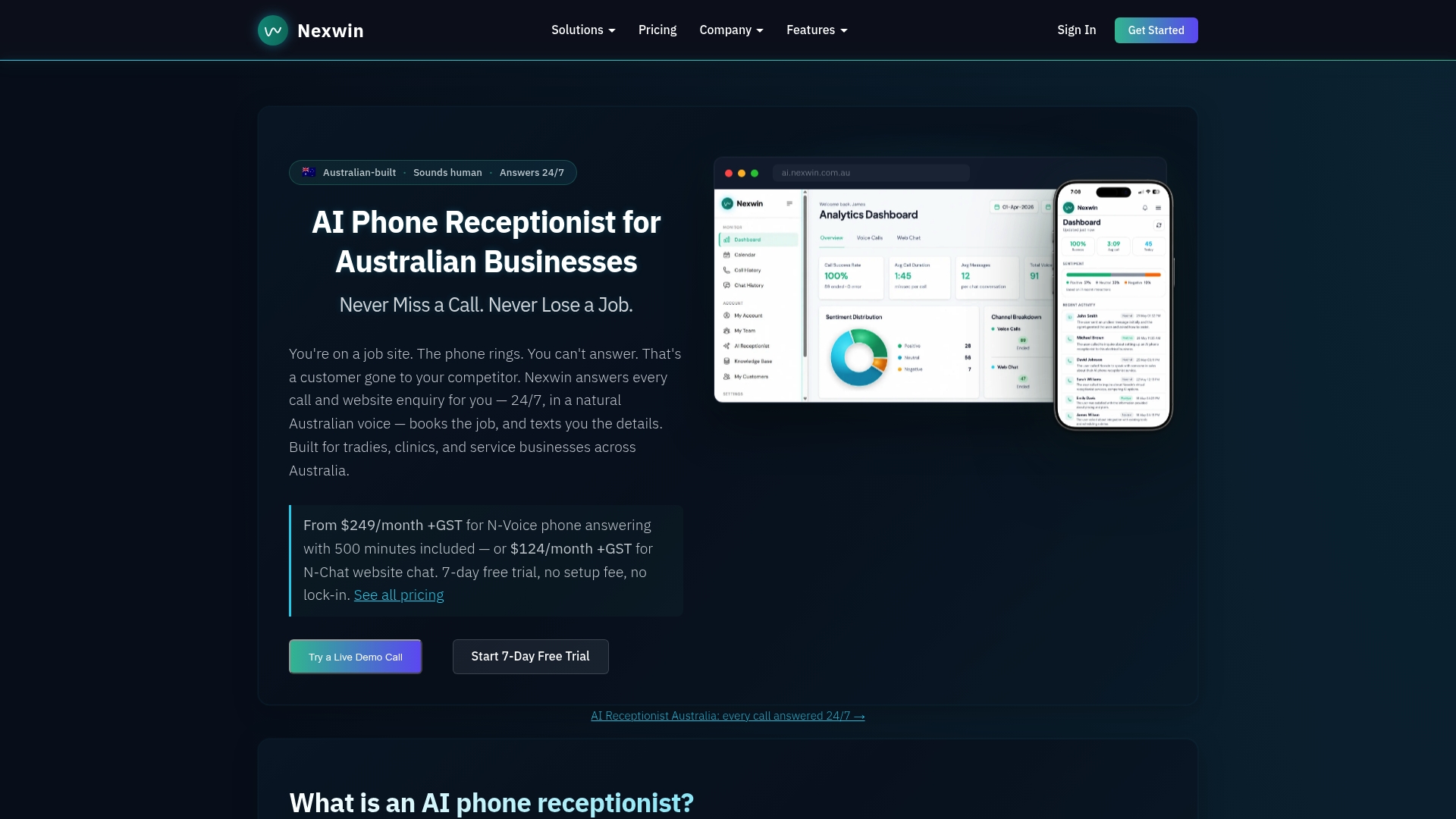
For trades, clinics, real estate agencies, and other service businesses, Nexwin operates on a straightforward monthly subscription with no setup fees and a free trial to get started. Whether you run a solo trade operation or a multi-practitioner clinic, there is a plan sized to your call volume. Start your free trial and see how many calls your business is currently missing.
Sources
- Conversation Design Institute — IVR topic
- What Is IVR? - Interactive Voice Response Explained - AWS
- Natural language processing — Wikipedia
- Conversational Interactive Voice Response (IVR) and Natural Language IVR | TTEC